
Richmond Concrete Experts grinds and polishes concrete floors for Richmond businesses and homeowners: showrooms, offices, breweries and restaurants, maker spaces and artist studios, warehouse lofts, and modern homes on slab. Polished concrete uses the slab you already have as the finished floor. There's no coating on top, so there's nothing to peel, chip, or wax.
What Makes a Floor "Polished"
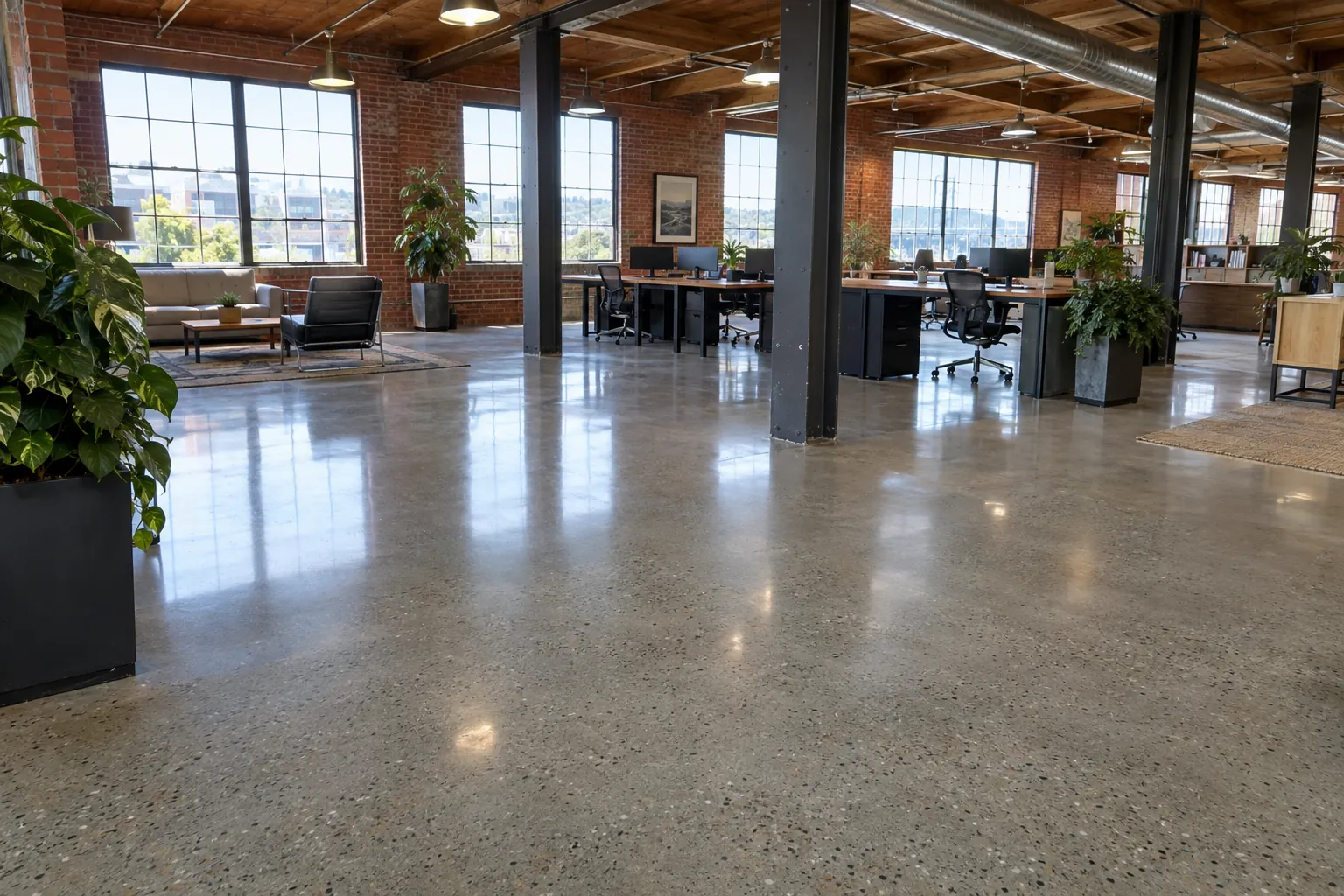
A polished floor is the concrete itself, ground flat and refined until it reflects light. It's done with heavy planetary grinders and a sequence of diamond tooling, each step finer than the last.
The core sequence
1. Grind with coarse metal-bond diamonds to remove old coatings, glue, and the weak surface, and to flatten high spots. 2. Fill cracks, joints, and pinholes with a cement grout or semi-rigid joint filler. 3. Densify with a lithium or sodium silicate densifier that reacts with the concrete and hardens the surface. 4. Hone and polish with resin-bond diamonds, stepping up through finer grits until the floor reaches the gloss you chose. 5. Guard the surface with a penetrating stain guard that helps resist spills.
Grinding runs with dust extraction, which matters in occupied buildings and homes.
Choosing the Look
Gloss level
From a low-sheen satin to a mirror-like high gloss. Higher gloss takes more polishing steps.
Aggregate exposure
- Cream finish: a light grind that keeps the smooth top paste, for a uniform, minimal look - Fine aggregate: a slightly deeper grind that shows sand and small stone, often called salt-and-pepper - Full aggregate: a deep grind that reveals the larger stone, for a terrazzo-like floor
Exposure depends on how deep the first grind goes and what aggregate is in the slab, so we look at the floor, and sometimes grind a test patch, before promising a look.
Color
Penetrating dyes can be applied during polishing for color that won't peel. Borders, bands, and logos can be scored and dyed into the floor.
Old Slabs and Warehouse Floors
Richmond has a lot of older industrial and commercial buildings, from the port area to the converted spaces near downtown and Point Richmond. Many have slabs with decades of paint, mastic, and patches. Those floors can often be polished into something with real character, with the old patches and saw cuts left as part of the look, or filled and blended if you want a cleaner floor.
Floors with severe cracking, heavy settlement, or large missing areas may be better candidates for a coating. We'll tell you which way we'd go after seeing the slab.
Concrete Floor Grinding Only
Sometimes the job is just grinding. We grind to:
- Remove carpet glue, tile mastic, paint, and epoxy before new flooring
- Flatten lips at joints and high spots
- Prepare a slab for an epoxy coating or overlay
Polished Concrete at Home
New homes, ADUs, and additions with slab foundations can be finished as polished floors, especially when the slab is planned for it at the pour. Radiant floor heating pairs well with concrete, and area rugs soften it in living spaces. See foundations & ADU slabs.
Living With a Polished Floor
Maintenance is simple: dust-mop daily in busy spaces and clean with a pH-neutral cleaner. Acidic spills like wine, vinegar, and citrus can etch the surface if left sitting, so wipe them up. High-traffic paths can be re-burnished over time to bring the shine back without regrinding.