
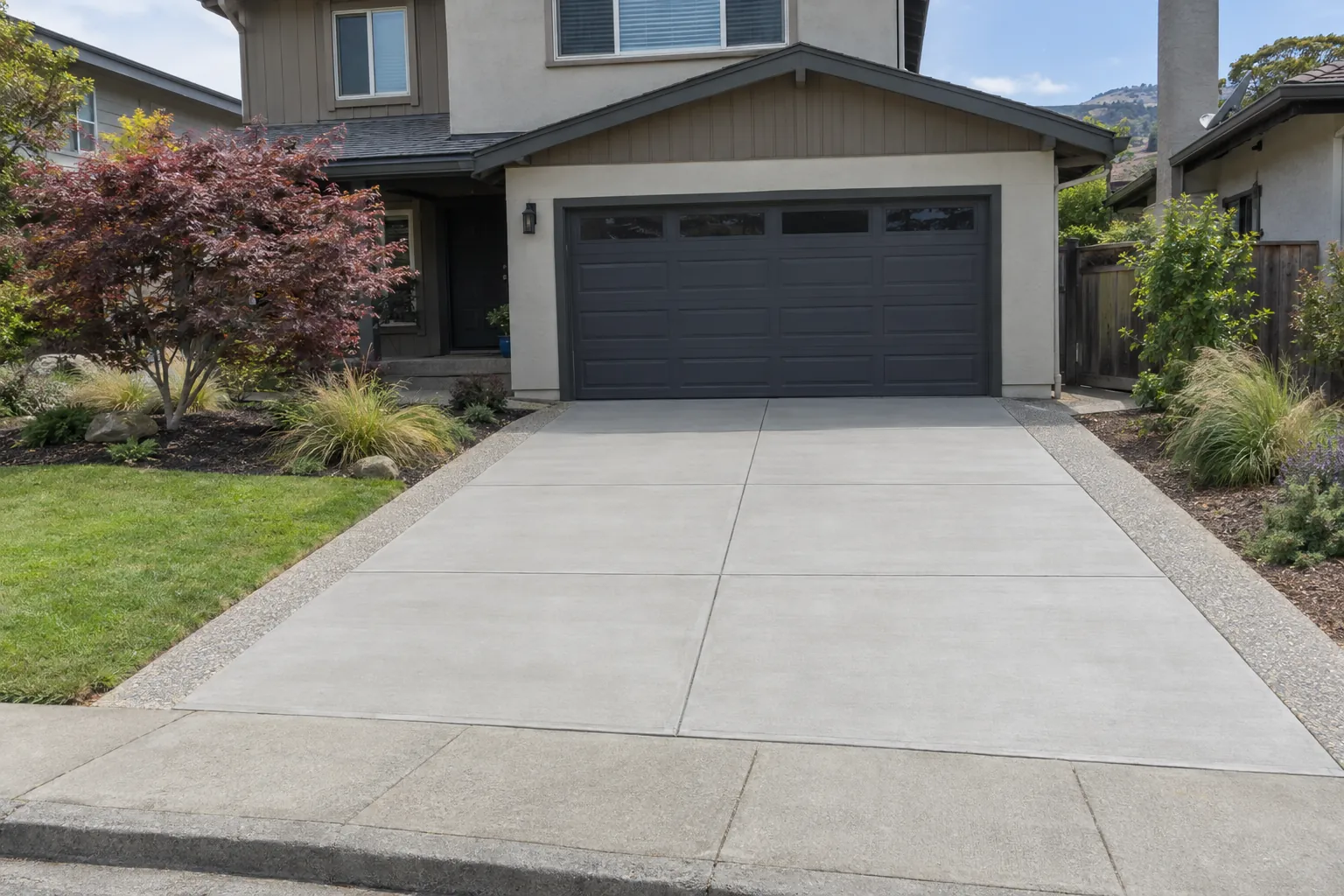
Richmond Concrete Experts builds new concrete driveways and replaces worn-out ones across Richmond, from narrow 1940s drives in the Richmond Annex and Atchison Village to steep, curving driveways up in Richmond Heights. Every concrete driveway we quote comes with the thickness, base, steel, finish, and permit plan written down before anyone picks up a shovel.
What a Richmond Driveway Has to Survive
Richmond driveways don't fail from frost. They fail from water and moving ground. Along the flats near the bay, many lots sit on Bay mud or old fill that settles unevenly under load. In the hills, clay soils swell through the rainy season and shrink again by late summer, and slopes creep slowly downhill. Add a street tree whose roots have been working under the old slab for sixty years, and you get the cracked, tilted, heaved driveways you see all over town.
A good driveway here is designed around those problems: a firm base, enough steel to hold the slab together if the ground shifts, slope that sends winter storm water where it belongs, and joints that control where cracking happens.
How We Build a Concrete Driveway
- Tear-out and dig. Old concrete or asphalt is broken out and hauled to a recycler. We dig below grade to remove organic topsoil and soft spots.
- Base. 4 inches or more of Class II aggregate base, compacted with a plate compactor or roller. On soft Bay mud or wet clay we dig deeper and add more base where the soil calls for it.
- Forms and grade. Forms are set so the driveway falls about 1/8 to 1/4 inch per foot away from the garage and the house, toward the street or a drain.
- Steel. #3 or #4 rebar on chairs, typically 18 to 24 inches on center, tied where the slab meets the garage slab or an existing walk.
- Pour and finish. A 3,000 to 4,000 psi mix is placed, screeded, floated, edged, and finished.
- Joints and cure. Control joints are tooled or saw-cut the same day, spaced at roughly 2 to 3 times the slab thickness in feet, and the slab is kept moist or coated with curing compound.
How thick should a driveway be?
4 inches handles cars and SUVs on a good base. Where pickups, work vans, boats, or RVs park, we go to 5 or 6 inches and thicken the edges where tires roll on and off.
The Driveway Approach and City Permits
The driveway approach is the sloped section between the sidewalk and the street, plus the curb cut. In Richmond, it sits in the public right-of-way, and the city requires an encroachment permit for any work on the sidewalk, driveway approach, or curb and gutter. Replacing pavement there also means a refundable deposit and a city inspection. We handle the permit as part of the job, so the approach is built to city standards and passes inspection the first time. Our Richmond concrete permits guide explains what applies to which project.
Finishes Richmond Homeowners Choose
Broom finish
The standard: a light broom texture across the slab for traction on wet winter mornings.
Exposed aggregate
A Bay Area favorite. The top layer of cement paste is washed off to reveal the stone underneath, which hides tire marks and wears well. See stamped & exposed aggregate.
Borders and bands
A smooth-troweled or colored border, or a stamped band along the edges, dresses up a plain gray drive without the cost of stamping the whole thing.
Widening, Parking Pads, and Steep Driveways
Many older Richmond homes have a single-car driveway and a household with three cars. We widen driveways with doweled extensions tied into the existing slab, add side parking pads, and pour pads for trailers and boats. On steep hillside driveways we add a deeper, rougher texture for grip and plan drainage so storm runoff doesn't sheet across the slab or into the garage. If the driveway cuts into a slope, a retaining wall is often part of the same project.
Repair or Replace?
A few cracks or lifted panels don't always mean a new driveway; see concrete repair. When the slab is broken in many places or the base has failed, replacement is the better value.
Care After the Pour
Keep cars off for about 7 days and heavy trucks off for about 28. A penetrating sealer after the first month helps the slab shed water and resist oil stains.
For budgeting, see our concrete cost guide or compare concrete vs. pavers.