
Richmond Concrete Experts pours concrete slabs and pads across Richmond for the things homeowners actually need a flat, solid surface under: backyard sheds, hot tubs, detached garages, carports, trash and recycling enclosures, and parking for an RV, boat, or work trailer. Every concrete slab starts with the same question: what is going to sit on it, and what is the ground underneath like?
Sizing a Concrete Slab for the Load
The load decides the thickness, the base, and the steel. Here is how we usually plan the common ones:
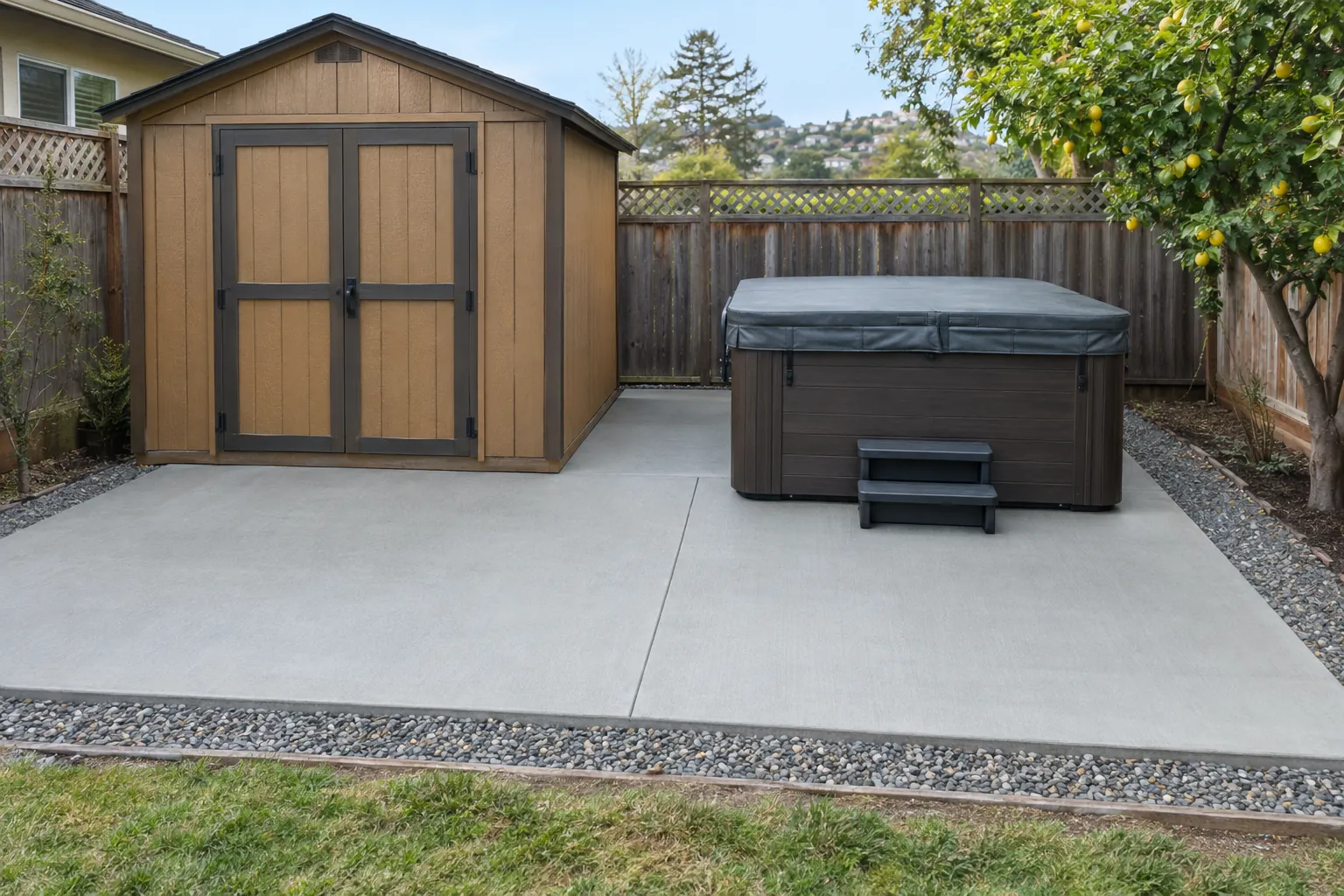
- Shed and storage pads: 4 inches of concrete, with the slab extending a few inches past the shed walls so rain sheds off the edge instead of under the building.
- Hot tub pads: 4 to 6 inches depending on the tub. A filled spa with people in it can weigh several tons, so we check the manufacturer's pad requirements before forming.
- Detached garage and carport slabs: 4 to 5 inches with thickened edges, where the walls or posts bear, and anchor bolts or post bases set while the concrete is wet.
- RV, boat, and trailer pads: 5 to 6 inches with heavier reinforcement, because a loaded RV puts much more weight on a few square feet of concrete than a car does.
Thickened edges matter. Under a garage wall or along the side where tires roll on, we deepen the slab edge so the load spreads into the ground instead of cracking the corner off.
The Base Under a Richmond Slab
Most slab problems in Richmond come from the ground, not the concrete. On the flats near the shoreline, a lot of lots sit on fill over Bay mud, which compresses and settles unevenly under weight. In the hills and in much of the East Bay, clay soils swell in the rainy season and shrink in the dry months.
So before we form anything, we strip topsoil and roots, dig out soft or organic material, and place Class II aggregate base, compacted in layers with a plate compactor. Soft spots get dug deeper. On sloped lots we set the pad level and plan for where the uphill water goes, which sometimes means a short curb, a drain, or a small retaining wall.
Reinforcement, Joints, and Anchors
Rebar or mesh
Most pads get #3 or #4 rebar on chairs, typically on an 18 to 24 inch grid, so the steel sits in the middle of the slab where it does its job. Light shed pads can use welded wire mesh, as long as it is lifted into the concrete instead of left lying on the base.
Control joints
Concrete shrinks as it cures. Control joints, cut or tooled at roughly 2 to 3 times the slab thickness in feet, give it a straight place to crack. A 10 x 12 shed pad may need one joint; a 12 x 40 RV pad needs several.
Anchors and conduit
Anything that needs to go into or under the slab, such as anchor bolts, hold-downs, electrical conduit for a hot tub or garage, or a floor drain, gets placed before the pour. Retrofitting later means drilling and patching.
Moisture and Vapor Barriers
Slabs that will sit under an enclosed building, such as a garage or a finished shed, usually get a vapor barrier over the base to keep ground moisture from wicking up into the floor and anything stored on it. Open pads, like an RV pad or a hot tub pad outdoors, typically don't need one.
Drainage and Slope
Even a "flat" pad is built with a slight fall, usually about 1/8 inch per foot, so rain runs off instead of puddling. During a wet Richmond winter, a pad that pitches toward the house or a fence line can send water exactly where you don't want it, so we decide the drain direction before the forms go in.
Pad Finishes
A light broom finish is standard for outdoor pads because it holds traction when wet. Garage and shed floors are usually troweled smooth so they are easy to sweep, and can be coated later with an epoxy garage floor system. Outdoor pads near the bay benefit from a penetrating sealer to keep water and salt air out of the surface.
When a Pad Becomes a Foundation
If the slab will support a habitable building, such as a backyard cottage, an addition, or a converted garage, it's a structural foundation with its own engineering and permit, not a simple pad. See foundations & ADU slabs for how those are handled.